
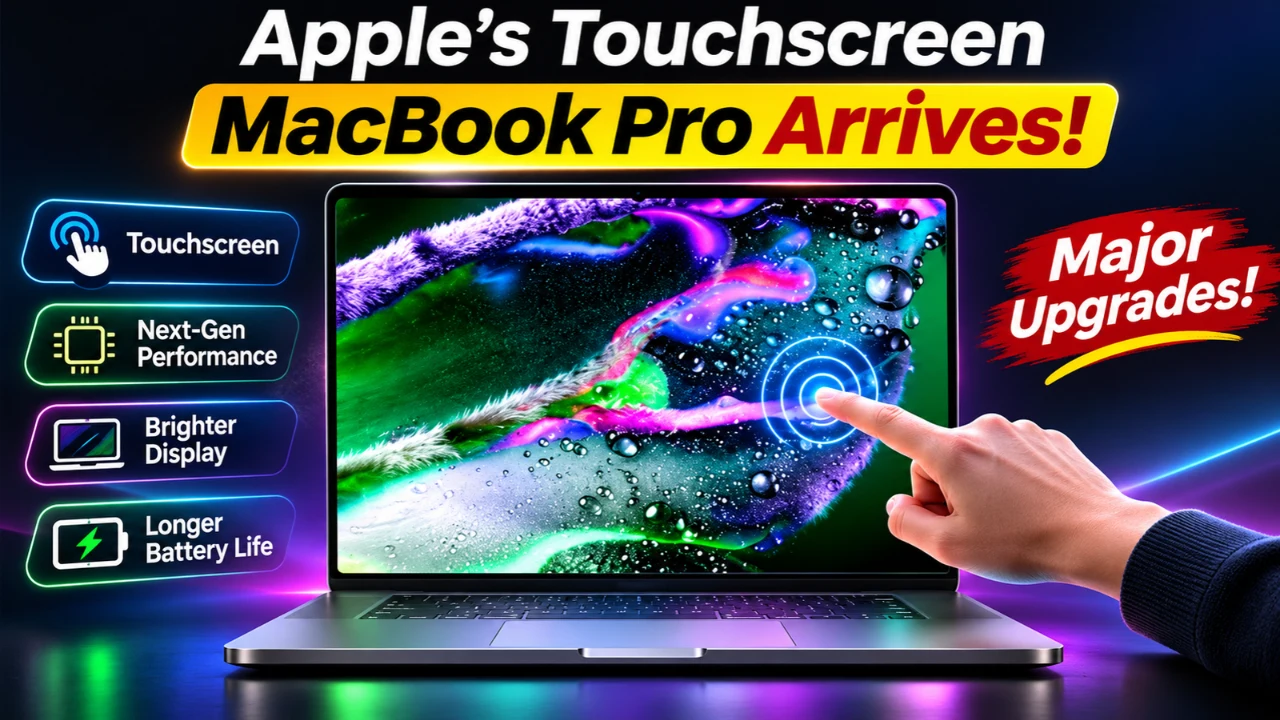
Apple has officially entered a category it resisted for years. The company has unveiled its first-ever touchscreen MacBook Pro, introducing touch input alongside the traditional keyboard and trackpad. The redesigned laptops also debut an OLED display, a lighter chassis, and several hardware improvements aimed at creative professionals.
For U.S. customers, this is one of Apple’s biggest Mac updates in recent years. The new models target professionals who want the flexibility of direct touch interaction without giving up the familiar macOS experience, while still positioning the MacBook Pro as a premium productivity device.
What’s New in the Touchscreen MacBook Pro?
The redesigned MacBook Pro introduces several firsts for Apple’s notebook lineup.
Key highlights include:
- Apple’s first touchscreen MacBook
- 14-inch and 16-inch models
- Touch-enabled PROLED XDR (OLED) display
- M5 Pro and M5 Max processors
- Redesigned hinge engineered for touch interaction
- Slimmer and lighter aluminum design
- Dynamic Island replacing the traditional display notch
- Improved thermal cooling system
- Higher display contrast and richer colors
Apple says the touchscreen MacBook Pro complements not replaces the keyboard and trackpad, giving users another way to interact with macOS.
Read Also-iOS 18 Battery Drain Fix: New Tips Every iPhone User Needs
Why Apple Finally Added a Touchscreen
For years, Apple argued that touchscreens worked better on iPads than laptops. The company’s approach has now evolved.
According to Apple, the new design focuses on:
- Creative workflows
- Photo and video editing
- Faster navigation
- More intuitive content interaction
- Enhanced productivity for professionals
Rather than turning macOS into iPadOS, Apple has optimized macOS so touch gestures work naturally alongside traditional input methods. The redesigned hinge also minimizes screen wobble when users tap or swipe the display.
Pricing, Availability and Who Should Buy It
Apple positions the touchscreen MacBook Pro as a premium product.
Starting prices (U.S.)
- 14-inch model: Starting around $2,899
- 16-inch model: Starting around $3,399
Preorders opened following Apple’s announcement, with retail availability beginning November 6, 2026 in the United States and other launch markets.
Best suited for:
- Video editors
- Software developers
- Photographers
- Graphic designers
- Music producers
- Content creators
- Professional users needing maximum performance
What U.S. Buyers Want to Know
Does it replace the regular MacBook Pro?
No. Apple continues offering standard MacBook Pro models, while the touchscreen versions are positioned as premium options.
Does it support touch-only navigation?
Yes, but Apple recommends using touch together with the keyboard and large Force Touch trackpad for the best productivity experience.
Will Apple Pencil work?
Apple has not announced Apple Pencil support for the touchscreen MacBook Pro. Current official information focuses on finger-based touch input.
Is battery life changing?
Apple says the redesigned hardware and updated display technology continue to provide long battery life while improving image quality and efficiency.
Read Also-Apple TV 4K Upgrade Is Here: Biggest Changes Explained
How to Decide if the Touchscreen MacBook Pro Is Right for You
If you’re considering an upgrade, follow these steps:
Step 1
Decide whether your work benefits from direct touch interaction, such as editing photos, drawing workflows, or creative production.
Step 2
Choose between the 14-inch and 16-inch model based on portability versus screen size.
Step 3
Select the appropriate M5 Pro or M5 Max configuration depending on your workload.
Step 4
Compare storage and memory options before ordering.
Step 5
If you already own a recent MacBook Pro and don’t need touch input, compare your current performance with the new features before upgrading.
Step 6
Order through Apple’s official channels or authorized U.S. retailers to receive warranty coverage and support.
Final Thoughts
Apple’s touchscreen MacBook Pro marks one of the most significant changes to the Mac lineup since the transition to Apple silicon. By combining a touch-enabled OLED display, redesigned hardware, M5 Pro and M5 Max chips, and optimized macOS interactions, Apple is expanding how professionals can use the Mac without abandoning its traditional desktop experience. For many U.S. buyers especially creators and power users the new models offer a compelling blend of familiar productivity and modern touch functionality, though the premium pricing means they’re aimed squarely at high-end users rather than the mass market.
Read Also-Apple iPhone Duo Gets Major Attention: What Buyers Should Know