
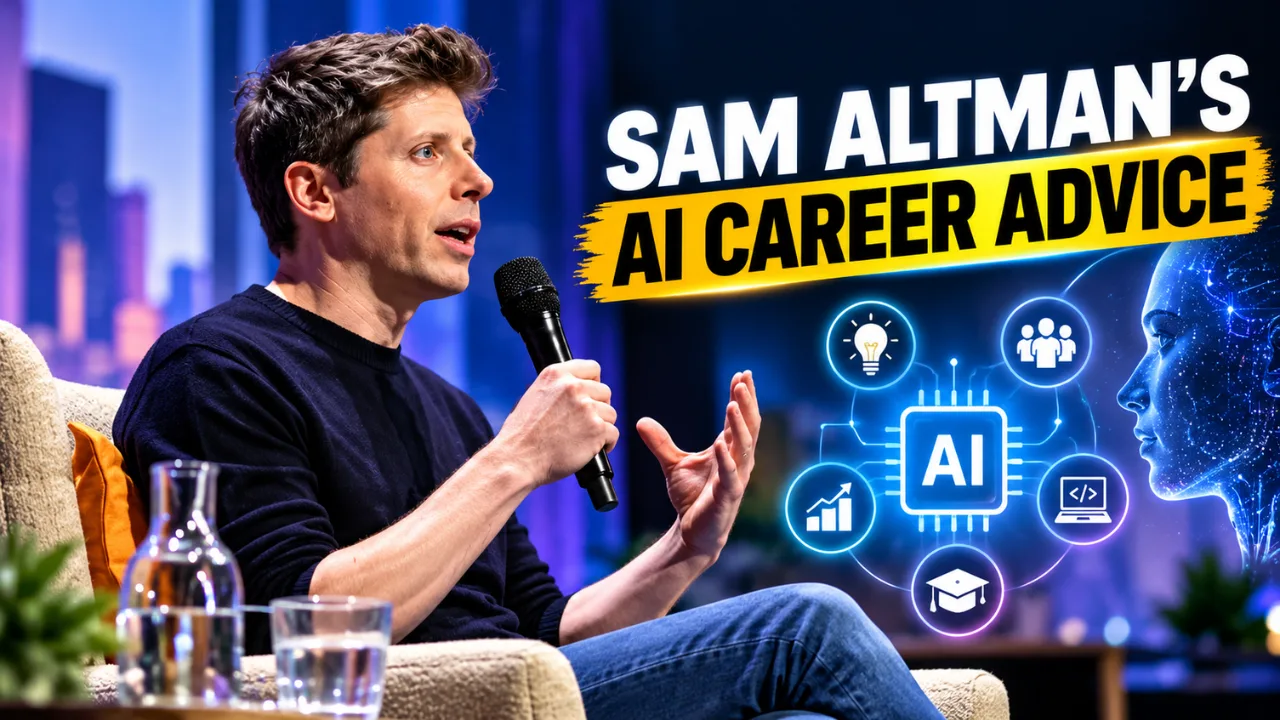
OpenAI CEO Sam Altman is urging young professionals to rethink traditional career planning as artificial intelligence rapidly reshapes the global job market. Speaking during a recent discussion at Stanford Graduate School of Business, Altman argued that the biggest opportunities won’t come from following yesterday’s career trends they will come from building new businesses and skills around AI. His comments arrive as companies across the U.S. continue investing heavily in AI tools, automation, and next-generation software.
Rather than predicting widespread job losses alone, Sam Altman emphasized that technological disruption also creates rare opportunities. His message to students and early-career professionals was simple: don’t spend your career chasing what worked five years ago build what comes next.
Read Also- Claude Duet App Launches: Here’s What US Users Need to Know
Why Sam Altman Thinks Young Workers Have a Unique Opportunity
According to Sam Altman, artificial intelligence will transform many existing jobs by automating tasks that are repetitive, data-driven, or highly structured. However, he believes this transition creates one of the best environments in decades for entrepreneurs and innovators.
His key points included:
- AI will perform many current tasks faster and at lower cost.
- Entire industries will evolve rather than disappear overnight.
- Young professionals should focus on creating new products, not simply competing for traditional roles.
- Major technological shifts often reward people willing to experiment early.
Altman also noted that these changes are unlikely to happen all at once. Instead, he expects a gradual transformation that gives workers time to adapt provided they continue learning new skills.
Sam Altman Biggest Criticism of Traditional Career Thinking
One remark from Altman’s Stanford appearance quickly gained attention online.
He said his “chronic disappointment” with many MBA students is that they often pursue industries or business models that were successful several years ago instead of exploring opportunities created by AI. His broader point wasn’t directed at business schools alone, it was a challenge to rethink conventional career planning during a period of rapid technological change.
For American students and professionals, the takeaway is practical:
- Don’t rely only on established career paths.
- Learn how AI changes your industry.
- Develop skills that complement AI rather than compete with it.
- Look for problems that new AI tools can solve.
Sam Altman believes the most successful founders of the next decade may build companies that don’t exist today.
Read Also-iOS 27.2 Arrives With Smarter Siri and 160+ Security Fixes
What U.S. Workers Want to Know: Will AI Replace Jobs?
One of the biggest questions in the United States is whether AI will eliminate large numbers of jobs.
Sam Altman acknowledged that many workplace tasks will eventually be handled by AI, but he also stressed that history shows new technologies often create entirely new professions alongside automation. He encouraged workers to prepare for changing job descriptions instead of assuming every role will disappear.
For Americans entering the workforce, experts increasingly recommend building strengths in areas such as:
- AI literacy and prompt engineering
- Software development
- Product management
- Cybersecurity
- Data analysis
- Creative problem-solving
- Communication and leadership
These capabilities are expected to remain valuable even as AI handles more routine work.
Entrepreneurship Could Become the Biggest AI Opportunity
Perhaps Altman’s strongest message centered on entrepreneurship.
He argued that today’s AI platforms make it possible for small teams to build products and companies much faster than in previous decades. He believes many future businesses built on top of AI technologies could eventually become larger than today’s leading AI companies.
For startup founders, students, freelancers, and independent creators, this could mean:
- Launching AI-powered software products.
- Building specialized tools for healthcare, education, finance, or retail.
- Creating automation services for small businesses.
- Developing AI-assisted content, design, or coding platforms.
His overall message is that periods of technological disruption often lower barriers for new entrants willing to move quickly.
How Young Professionals Can Prepare for an AI-Driven Career
If you’re starting your career or considering a change, here are practical steps inspired by Altman’s advice:
- Learn to use leading AI tools every day.
- Build skills that work with AI, not against it.
- Stay informed about emerging technologies in your industry.
- Consider side projects or startups that solve real problems using AI.
- Continue developing communication, leadership, and critical-thinking skills.
- Keep learning as technology evolves instead of relying solely on traditional career paths.
For many Americans, the AI era won’t simply be about replacing jobs it will be about adapting faster than previous generations had to.
Read Also-10 AI Work Task Automation Tips That Can Save You Hours Every Week