
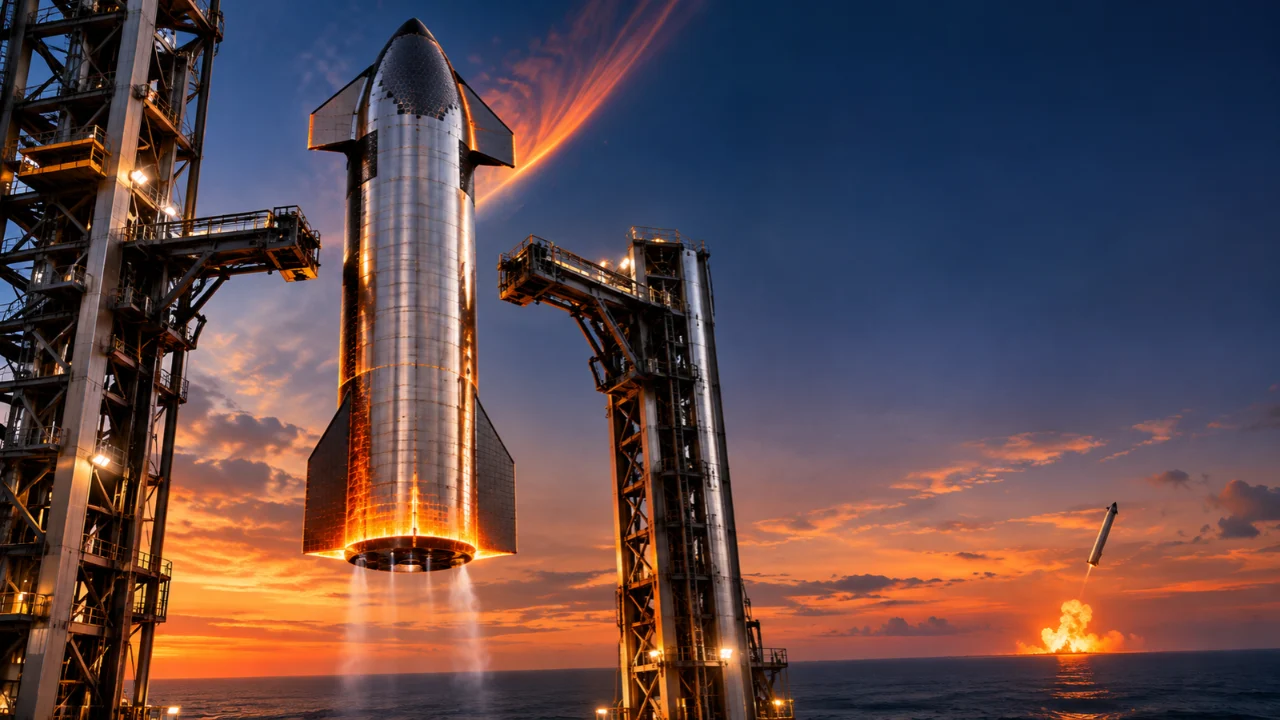
The SpaceX Starship midair catch happened Saturday, Nov. 14, 2026, when the launch tower’s giant mechanical arms grabbed the returning Starship spacecraft in Texas after a 22-hour orbital flight. It was a first for SpaceX’s upper stage. But the Super Heavy booster exploded over the Gulf of Mexico after an early engine shutdown, so the planned double catch fell short.
The SpaceX Starship Midair Catch, Step by Step
Flight 15 lifted off from Starbase, Texas, on Friday, Nov. 13, at about 5:47 p.m. ET. It was the 15th full-scale Starship flight since 2023 and only the second to reach orbit.
- The ship: Ship 42 completed 14 orbits at roughly 165 miles (265 km) up.
- The return: It reentered over the Pacific, flew supersonic across Mexico and the southwestern U.S., then lined up with the tower.
- The catch: The arms closed around it around 4:20 p.m. ET Saturday, about 22 hours after launch.
- The heat shield: SpaceX said the vehicle, including its heat shield, appeared to perform well.
SpaceX had caught its Super Heavy booster three times before. This is the first time it has caught the upper stage after a trip around the planet.
Read Also-FAA Ground Stop Router Update: What Caused the Nationwide Flight Disruption?
26 Starlink Satellites Deployed
Before coming home, the ship released 26 Version 3 Starlink satellites. That matches the number placed by the previous orbital flight on Sept. 28, according to a public flight list. Starlink had about 10,000 operational satellites as of Oct. 31, per a public tally.
Why the Booster Explosion Ruined the Double Catch
SpaceX wanted to catch both stages on one flight. That did not happen.
- SpaceX’s Kate Tice said the booster’s engines stopped firing too early on the way down.
- Its guidance system sensed it was off course and automatically diverted to the Gulf, then destroyed itself rather than risk the tower.
- The booster, B22, exploded before hitting the water. SpaceX engineers are investigating.
- One finance outlet reported a fuel-system flag. SpaceX’s stated explanation was the early engine cutoff, so treat the deeper cause as unconfirmed for now.
Why the Catch Matters
Catching the ship points toward full reusability, the idea of flying the same vehicle again quickly instead of building a new one. SpaceX says that is key to cheap launches, and it should help Starlink deployment costs over time.
- NASA: The agency is paying billions for a Starship lunar lander and is targeting a crewed moon landing as soon as 2028. NASA Administrator Jared Isaacman welcomed the catch.
- Open questions: Experts note reentry can damage heat shields or engines, and Starship has not yet shown a fast turnaround.
- What’s next: SpaceX plans Florida launches from Kennedy Space Center in the coming months.
What US Readers Want to Know
- Is the SpaceX Starship midair catch the first tower catch ever? No. The booster has been caught three times. This is the first ship catch after orbit.
- Was anyone on board? It was an uncrewed test carrying Starlink satellites.
- Could people in the U.S. see it? The return path crossed the Southwest, but reports focus on the flight itself, not viewing spots.
- When is the next flight? No date appeared in the reports I reviewed.
How to Follow Starship Updates: Step by Step
- Watch the replay of the SpaceX webcast’s reentry and catch segment.
- Read SpaceX’s flight recap for the official booster explanation.
- Look for investigation news on the booster loss from SpaceX or regulators.
- Track NASA’s Artemis updates to see how the SpaceX Starship midair catch affects the lander schedule.
- Check claims against official sources before sharing.
Read Also-Tesla Cybercab Orders Open: What $29,990 Really Gets You Today